
Grandpa had a knack for making his grandkids feel special, primarily by playing with us. With me, he played countless games of checkers at their kitchen table. I never won. Not once. I would have remembered.
Occasionally, I’d move a checker and leave my finger on it to signify that I was still thinking about the move. He’d say in his gruff, Oklahoma accent, “I doan thank ya wanna move that‘un thur.”
“Why not?”
“’Cuz, I’d foller up with dess here,” sliding his checker into the next logical position to illustrate, “force ya to jump, and line me up a triple,” tracing the path of the impending damage with his finger.
”Hmm,” I’d pull my finger back, study the board, and pretend the previous idea hadn’t really been under serious consideration.
Even after saving me a few double- or triple-jump mistakes during a game, he’d still win.
He once told me, “Ya wanna play from the single corner, not the double corner. Playing from the single corner puts you in a stronger position, so ya wanna play outta it.”
I’m not sure I understood the logic at the time, but he held to it, and I still play that way today when I sit opposite a kid with a checkerboard.1
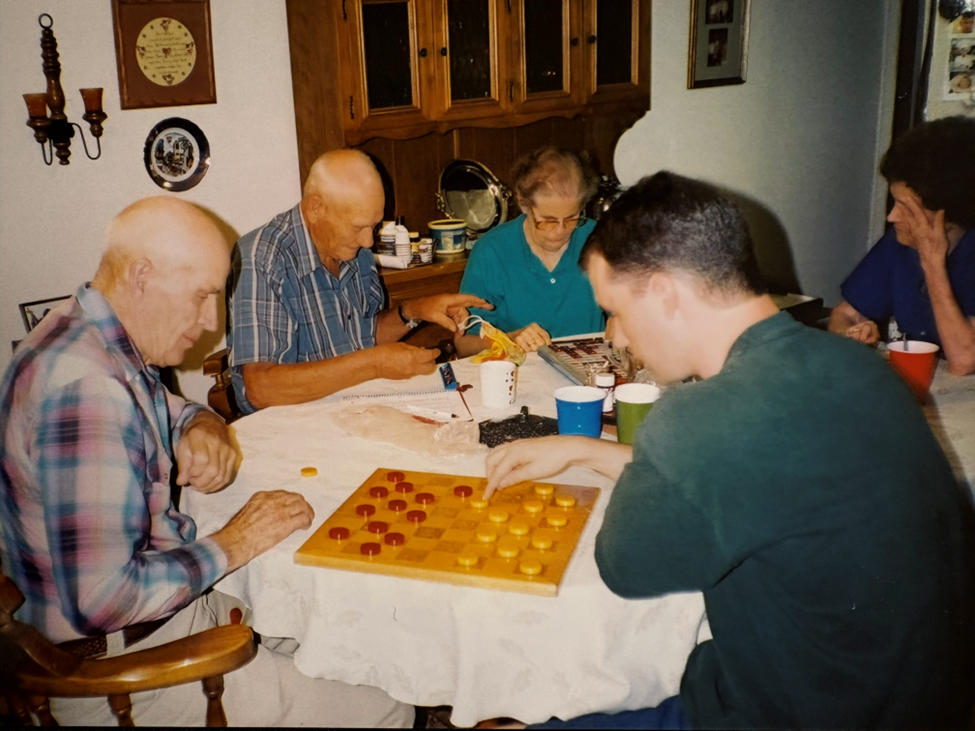
Grandpa and I played many matches on this old wooden checkerboard with its accompanying red and yellow checkers. My extended family will all recognize it instantly. There’s nothing particularly special about it, save the memories of Grandpa allocating his time to me for this experience.
When my grandparents passed, this checker set was the only thing I wanted. It resides in our living room to this day. I pull it out occasionally to play the neighbor kid. It feels a bit like passing the torch.
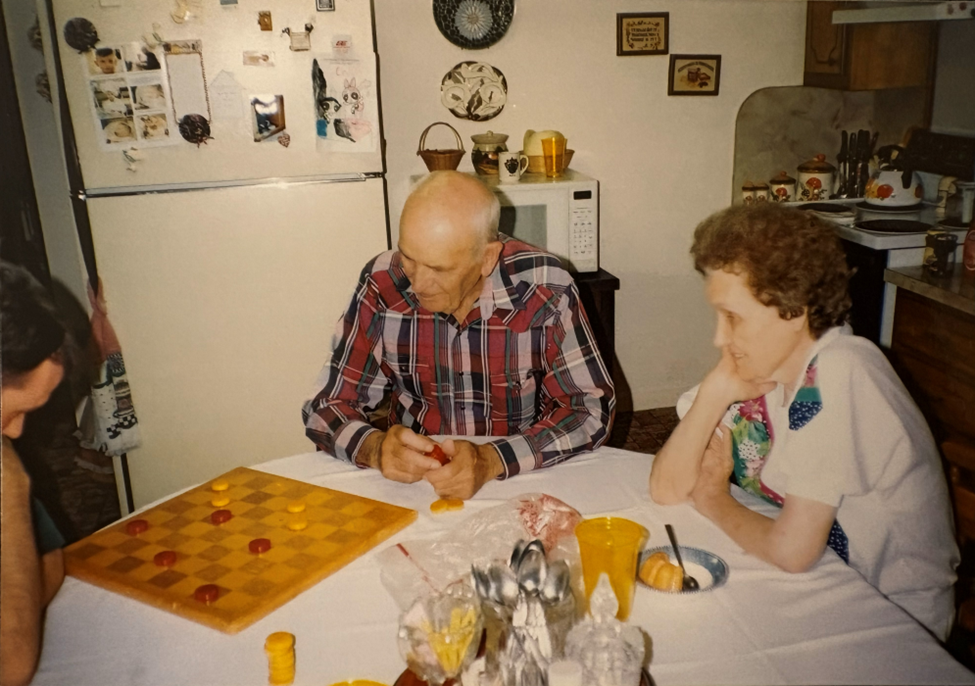
“I reckon I’ll push this ‘un here,” he said.
You can tell by the look on his face that I’m now the one in a dubious position. I’m 100% going to lose both of my lead pieces without a trade… and I have no options.
Grandma’s face says it all. Even she knows that Grandpa just put me in a vice, with one less checker piece than me.
Incidentally, I asked ChatGPT to study this picture and the board to assess who will likely win the match.
Answer: “yellow (older man) likely has the edge, but not decisively.”
Turns out, it was decisive.
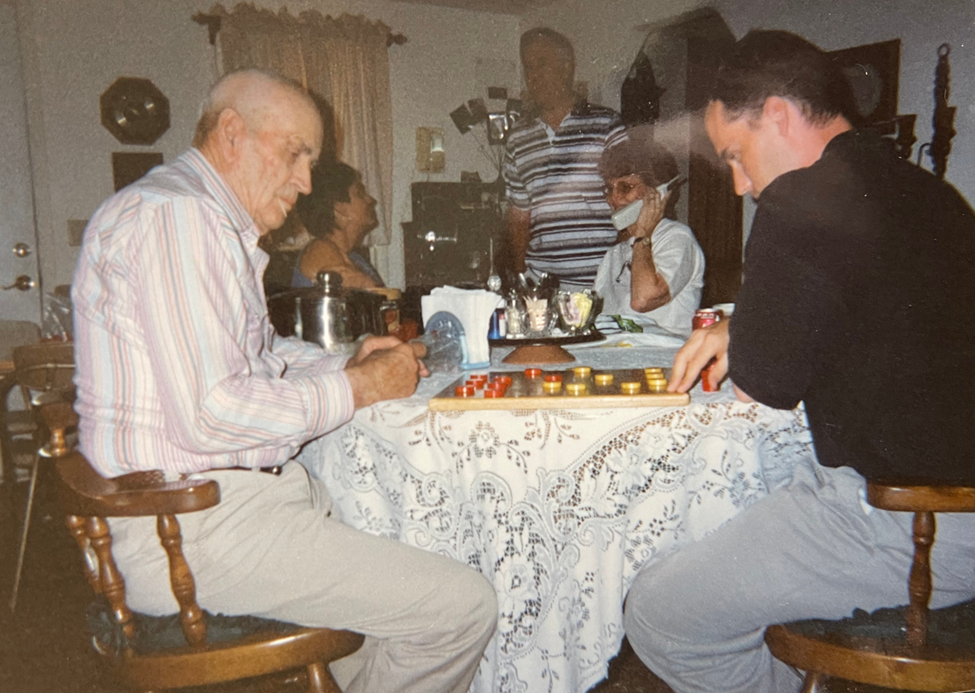
Playing a Different Game
Years later, perhaps 2007-ish, I was back at my grandparents’ house. Grandpa and I had finished a few games of checkers when he said,
“Hang on, I got somethun I wanna show ya.”
He walked to the back of the house and returned with some paper statements from his financial advisor. He handed them to me.
“Whadaya thank ‘bout this here?”
Grandpa had money with a large, brand-name bank acting as his financial advisor. This well-known firm sold him mortgage-backed securities (pre-2008), pitching that they were packaged and securitized as a basket of diversified loans, and thus provided attractive returns (~9% annual interest, I recall) with lower risk. Which was true. Until it wasn’t.
I had previously worked as an investment banker in London. So, I suppose Grandpa wanted my take on these investments.
I sat back down at the end of the kitchen table, my back to the front door. Grandpa took the seat beside me, closer to the wall-mounted gas furnace, as I reviewed the paperwork and the itemized securities.
I suspect, in the back of his mind, he suspected something might be suspect.
I was reluctant to give personal financial advice as I have learned there’s very little upside in that.
“I can’t tell you if these are good investments or not, but I do know this, the interest you get on products like these is commensurate with the risk you assume in owning them,” I told him. In other words, there’s no free lunch.3
Back then, inside the financial industry, selling a client a terrible product to get it off the bank’s balance sheet was called: ripping the client’s face off. It was often worthy of a high sales commission. Transferring risk from the bank to the client is great for the bank… less so for the client. If sold well, the client would even thank the salesperson for letting them get the inside scoop on this terrific opportunity. What a deal!
I left that conversation with Grandpa quite perturbed at the financial advisor for selling him this complex financial instrument with a questionable risk profile. Grandpa was in his 80’s at the time. At that age, investments should almost exclusively be about preserving capital, not speculative… and certainly nothing fancy and newfangled.
The Irony
We know how the story unfolded with mortgage-backed securities in late 2008-2009, so I won’t rehash that here. Suffice it to say, the financial system melted down… so much so, the federal government stepped in to backstop bank losses.
I was not a fan of the 2008-2009 government bailouts of the big banks, the automotive industry, and others. Still, the irony remains: Although Grandpa was unaware he was investing from the double corner, his mortgage-backed securities investments were ultimately “made whole” precisely because the Fed stepped in and backed them. In the end, Grandpa got his 9% annual returns, plus his principal back. Sometimes you get lucky.
This experience led me to formulate a somewhat cynical-but-true investment thesis:
It’s generally a bad idea to bet against the big Wall Street banks.
Maybe against an individual bank. But not against all of them. Collectively, the banks win. Put differently, the banks rarely lose.4 They simply have too much political influence, and the numbers are often too large to let them fail, by design.
Asymmetries
It’s difficult to reconcile this story with a fundamental notion that free markets should generally be “fair” and that outcomes should be based on investment merit. It’s not clear to me that’s the game we play when we invest in the public markets.
I understand this is a cynical view, but I have seen too many examples of asymmetry in information, asymmetry in bailouts, asymmetry in pricing, and asymmetry in practice.
Unlike checkers, where both players see all the pieces on the board and play by the same rules, in finance, there’s often asymmetric information. That asymmetry likely matters more than investment skill.
Trading the Corollary
In 2012, after the dust had settled from the financial crises, it occurred to me that there was a more positive corollary to the thesis above. If it was generally a bad idea to bet against the big banks, then perhaps it made sense to align with them (collectively), by owning a banking industry Exchange-Traded Fund (ETF).
I chose IAI, which tracks a basket of the largest financial institutions. I “invested” in it in 2012, though “gambled” might be more accurate. Nine years later, I sold my position, up roughly 500%.
We might call this the If You Can’t Beat ‘Em, Join ‘Em investment strategy.5 We may not be entirely sure how it works, but it also feels a lot like playing out of the single corner in checkers.
It’s simply advantageous to align yourself with the built-in structure of the game. This isn’t just an investment lesson. Life seems to have a certain flow about it as well.
Sometimes it makes sense to play against the board. But don’t make a habit of it.
The Bigger Picture
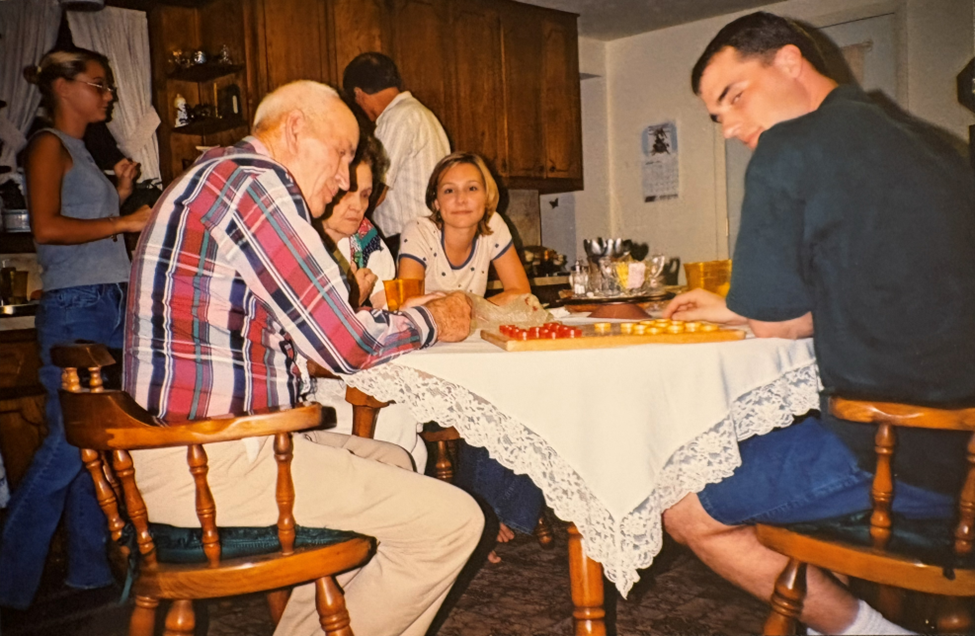
In the end, investments come and go, but what endures is this: I had a grandpa willing to share his time and attention with me, game by game across the years. The cadence was irregular, but his willingness to sit across the checkerboard from me was not. It wasn’t a lesson in strategy. It was an excuse to share time and be present. That was enough.
P.S. I was digitizing old photos. The “checkers with grandpa” motif in them was the impetus for this piece… which reminded me of the MBS investments he made and asked me about. I clearly remember thinking that somehow grandpa was investing in something I didn’t understand at the time.
I would later revisit the thought many times and pair it with multiple versions of uncle David saying (during conversations at the same kitchen table), “I just can’t believe people are getting approved for these loans. There’s no way they can pay them back or make the payments.”… a comment he made on the “stated income loans” that were popular at the time.
Looking back, I had all the intel needed to foresee the impending real estate crash of 2009… a signal lost in the noise of trying to beat grandpa in checkers and the general commotion of all the family gathering in the kitchen at their house “on the hill”.
Related posts:
Follow Past Midway if you would like an email notification when I post something new.
FOOTNOTES:
- Pause thought to ask ChatGPT. The answer: “There is real strategic merit to playing out of your single-corner side in checkers. It’s one of the classic principles that strong players use, and it’s grounded in how piece structure and mobility work.” Well, I guess grandpa knew what he was talking about.
- On the other side of the table is my great uncle Don and my great aunt Jo… more commonly referred to as Don & Jo. Don & Jo had an interesting courtship in their youth. As the story goes, Uncle Don was on furlough from the Airforce, driving down the road when some girls pull up beside him at a traffic light having a great time. They apparently thought he was someone else, someone they knew. So, Jo invited him to a party. He went. Ten days later, Uncle Don and Aunt Jo were married. They had a fantastic marriage that lasted 65 years.
One evening at that same kitchen table, when I was even younger than pictured here, my cousin asked Uncle Don, “How do you know when you’ve found the right one?” Well, this was suddenly an interesting conversation because I had recently been wondering the same thing and I figured Uncle Don would have an informed view. All eyes and ears were on Uncle Don. He paused and said, “You know… when you know.”
This was a completely disappointing answer at the time. I assume my cousin thought the same. I was hoping for some great nugget of wisdom. And then, one day, it happened to me… when I met Sofie, who would later become my wife (after I managed to convince her that somehow me marrying up was good for her). - Caveat: I have in fact experienced several instances where there was a proverbial free lunch with some financial investments. Two were obvious arbitrage opportunities, one was an obvious investment, the last was the 7-to-1 pension contribution matching offered by Bear Stearns when I worked there… more on these in a future blog post.
- Except Bear Stearns and Lehman Brothers. Both collapsed around this time, for different but related reasons.
- Very little of the outcome had to do with any specific insight. It was more about deciding to ride the momentum of a system designed to protect itself. To be clear, I have plenty of stories of being unlucky in my investments. Most notably… when I decided to trade foreign currencies and hedge the U.S. dollar against the Swedish kronor (short dollar, long kronor). How could I have known that Russia was going to invade Ukraine around the same time, forcing a “flight to quality” to the dollar and the flight of money out of countries in the general region? Let’s just say that could have gone better.

Well I am certainly not a banker, investment broker, or even all that financially minded, but I do remember similar times with Dewey and with my own grandpa (Uncle David as many others call him). I like the correlation you’ve made and your writing is top-notch as always.
David – thanks for reading and for your comment. Much appreciated.